The problem
Education has a persistent research-to-practice gap. A large body of peer-reviewed research is difficult for educators and school leaders to access, interpret, and connect to immediate decisions. Meanwhile, consequential choices about curricula, intervention programs, and professional development are often made without timely, usable evidence.
General-purpose AI systems can make research easier to discuss, but they are not designed to provide a controlled evidence base, a consistent hierarchy of evidence, or transparent judgments about the strength and contextual relevance of the underlying research.
The solution
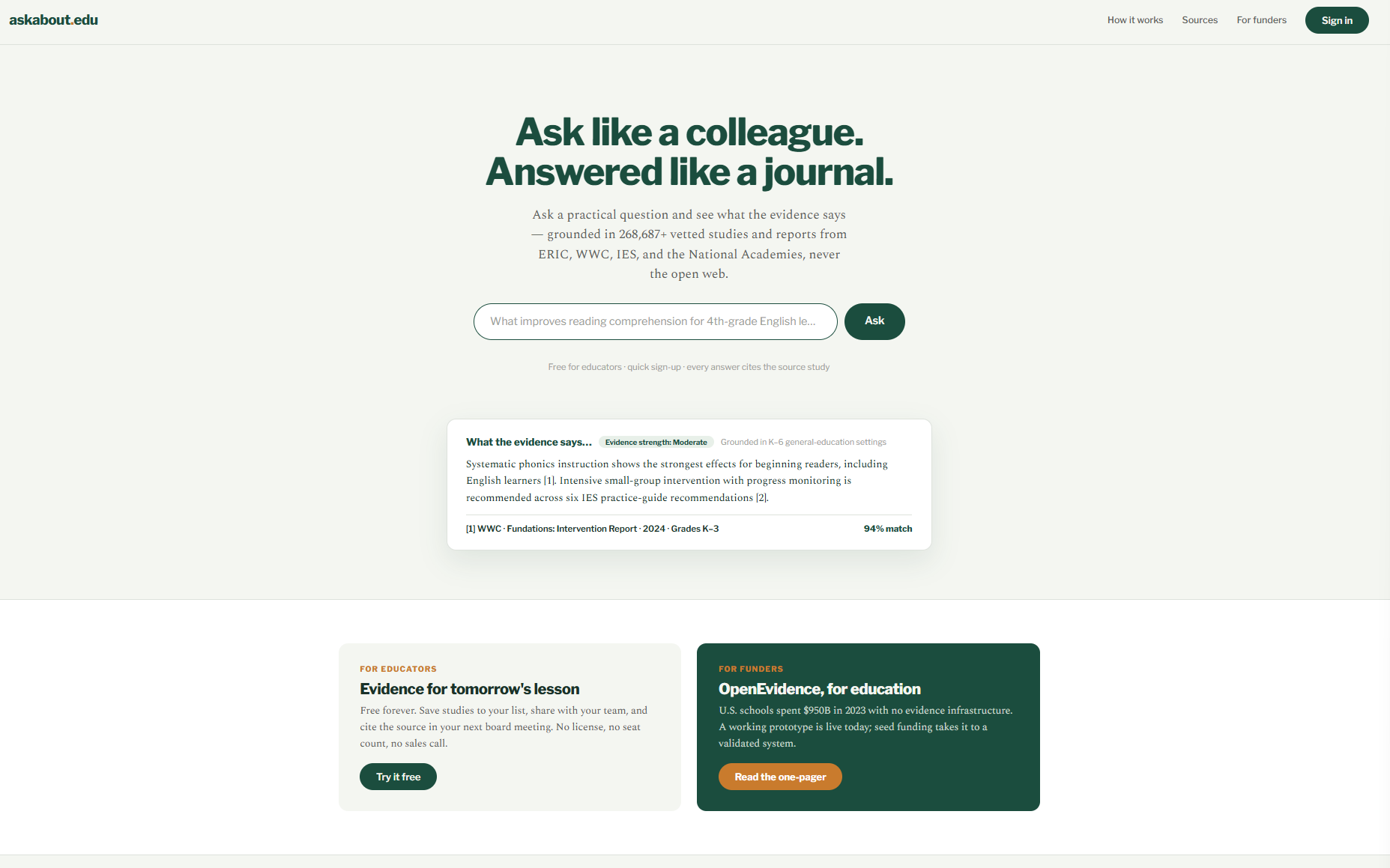
askabout.edu is an evidence-informed decision-support platform designed for practical education questions. An educator can ask a question such as, “What approaches improve reading comprehension for fourth-grade English learners?” The system retrieves relevant research from a curated corpus and returns a clear synthesis with citations, evidence-strength information, and the contexts in which the findings are grounded.
The platform is designed around curated educational research rather than unrestricted web search. My technical work includes retrieval from What Works Clearinghouse (WWC) intervention reports, with metadata and source excerpts preserved so users can inspect the evidence behind an answer.
From question to evidence-informed action
Ask in practical language
Users describe a program, outcome, population, or decision in the language they would use with a colleague rather than constructing a database query.
Retrieve verified evidence
The system searches a curated research corpus and prioritizes stronger forms of evidence, including systematic reviews and meta-analyses, over isolated single studies.
Interpret with context
Responses include transparent citations, an evidence-strength rating, and information about the populations and settings represented in the evidence.
Evidence by design
AskAboutEdu is being developed around several principles:
- Curated sources: Retrieval is constrained to verified educational research and evidence reports rather than the open web.
- Evidence hierarchy: Research syntheses and higher-quality evidence are prioritized when available.
- Transparent citations: Users can trace claims back to the underlying study or report.
- Calibrated conclusions: Responses distinguish strong, moderate, limited, and inconclusive evidence.
- Contextual grounding: The system surfaces the settings and populations represented in the evidence so users can judge how well it applies locally.
Current status
As of September 2026, the project has a deployed working prototype and an end-to-end pipeline for preparing and retrieving educational evidence. Corpus development and evaluation remain ongoing. This is a research and product-development initiative, not a claim that the system has completed broad effectiveness validation.
My role and the founding team
As Co-founder & Researcher, my contributions include:
- Designing and deploying an AI interface that connects LLMs with structured educational research evidence.
- Building a RAG pipeline with Python, Streamlit, and sentence-level embeddings to index and retrieve WWC intervention reports.
- Extracting, normalizing, and chunking long-form PDF reports into structured JSON corpora, while retaining document metadata for citation and traceability.
- Implementing evidence-constrained prompts that require responses to draw from retrieved excerpts, with explicit source attribution at the chunk level.
- Designing an interactive workflow for researchers, policymakers, and educators to explore and interpret primary-source evidence.
The founding team combines AI engineering, educational research, software design, and educational technology. This page describes the product initiative without implying that a legal entity has completed registration.
Next phase
The team is seeking seed funding to move from an early prototype to a validated system. The next phase will focus on:
- Core engineering and product reliability.
- Corpus expansion, verification, and evidence-ranking workflows.
- Pilot implementation with educators and education partners.
- Rigorous evaluation of usability, evidence quality, and decision-support value.